


5 Minutes a Day to Lower Anxiety, Promote Internal Harmony, and Create Resilience Against Disease

If you prefer, you can listen instead of reading - I read the article for you.
The audio includes a short demonstration of the coherence technique I'm discussing in my article below:
When you are recovering from an illness, stress and anxiety may be frequent visitors.
You are aware that prolonged stress and elevated cortisol are not helpful in this situation, actually the opposite.
You also know - or are told by an holistic health practitioner like me! - how important it is to regulate and bring your system out of the damaging ‘fight or flight’ into a state of ‘rest and repair’, where the body has a better chance to respond well to treatments and therapies, and healing can occur more readily.
The question is: how?
Perhaps you tried a few things but you struggle with finding the time and the consistency, and really get the benefits from the methods you have chosen, you struggle with meditation, for example, or to fully engage in your yoga class.
So, today, I want to tell you about a powerful tool that we all have within us. It’s something that can be accessed by anyone at any time to enter a state of physiological calm, energetic harmony, restoration and healing, in just minutes a day.
Self-regulating into coherence
In a recent new publication, the pioneering HeartMath® Institute discussed their latest research on their unique approach to bridging emotional and physiological (body) regulation.
The bottom line is: you don’t have to remain stuck in a stressed state. There are self-regulation techniques that can easily shift you from dysregulation to calm, a state they refer to as ‘physiological coherence’.
You may be thinking: this must be something that involves the brain. Yes. But there is a special gateway we can use to access the brain’s regulatory cascade.
The heart: a primary regulator of emotional and physical wellbeing
We tend to think of the brain as the main control centre of all body functions. In reality, there is a huge amount of information in the body that flows in the other direction, specifically from the heart to the brain.

The HeartMath® Institute has produced a wealth of evidence over the years, showing that our heart rhythms are a powerful, dynamic signal that constantly communicates with our brain, profoundly influencing our emotional state, as well as our physiological and cognitive function.
What our heart rhythm can reveal
We can track whether our body is in a state of chaos or calm by tracking our Heart Rate Variability (HRV).
HRV is not the heart rate (as in beats/minute), but the very tiny difference in time between each heartbeat. It reflects the ability of the heart to adapt constantly, and that adaptability (variability) is a direct window into the health and resilience of our entire nervous system.

When our systems are dysregulated, HRV is low, jagged and disordered. This is a signal that the body is stuck in a ‘fight or flight‘, creating interference with body systems’ optimal function.

On the other hand, high HRV reflects a state that is adaptable and resilient, a powerful predictor of wellbeing.
Why is it important to understand HRV?
Because HRV is not a fixed measure that we can’t modify.
On the contrary, HRV is a flexible and modifiable biomarker we can actively train and improve.
Isn’t that amazing?
In other words: by changing our HRV, we can easily and actively transition from a state of tension and stress into the flexible and resilient state of coherence, with all the benefits that this involves.
Shifting the Body from Chaos to Coherence
Optimising our HRV and achieving coherence is a skill that we can all learn.
HeartMath's scientifically-proven techniques are revolutionary because they are based on the intentional combination of emotions and physiology in three simple steps:
Step 1: Heart Focus: place your attention in the area of your heart
Step 2: Heart-focused breathing: consciously shift to a slower, deeper-paced breathing pattern, imagining your breath is flowing in and out of your heart or chest area. Find a rhythm that is comfortable for you. For most people, this is around six breaths per minute, or 5 seconds in and 5 seconds out
Step 3: Intentional generation of ‘regenerative’ emotions: as you continue your breathing, make a sincere attempt to experience a 'regenerative' feeling, such as a appreciation, gratitude, care, or compassion for someone or something in your life (e.g. a loved one, a pet, a beloved place, object or past memory).
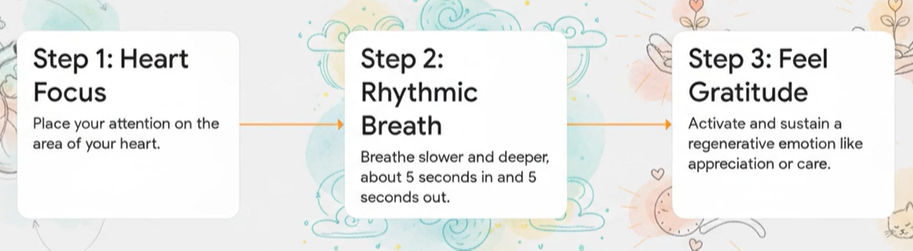
It is the activation of these renewing emotions from the heart that stabilises the coherent heart rhythm pattern.
This is a state of peak physiological efficiency, where the heart rhythmic pattern becomes so powerful that it acts as a ‘conductor’ of an orchestra. It literally pulls other systems in the body —like respiration and blood pressure—into the same synchronised rhythm of harmony and efficiency.
Imagine the widespread beneficial effects. All it takes is 5 minutes a day!

What coherence can bring into your life
When we are able to get ‘coherent’ with some regularity (even for just 5 minutes a day), we help our body to ‘relearn’ how to be calm.
This coherent state becomes your new normal, helping to regulate your emotions and physical health automatically.
Just 5 minutes daily for 4-6 weeks produced:
Reduced stress, anxiety & depression
Better sleep
Less pain
Improved focus, mood & emotional regulation
Increased brain volume in memory centres
Moreover, regular coherence practice has shown promise in studies that looked at chronic pain management, blood pressure regulation, reduction of symptoms of PTSD and depression, and recovery from cancer.
This makes coherence an accessible, non-pharmacological intervention that gives you a self-directed tool to regulate your own physiology in real time.
HRV-tracking technology can show our level of coherence
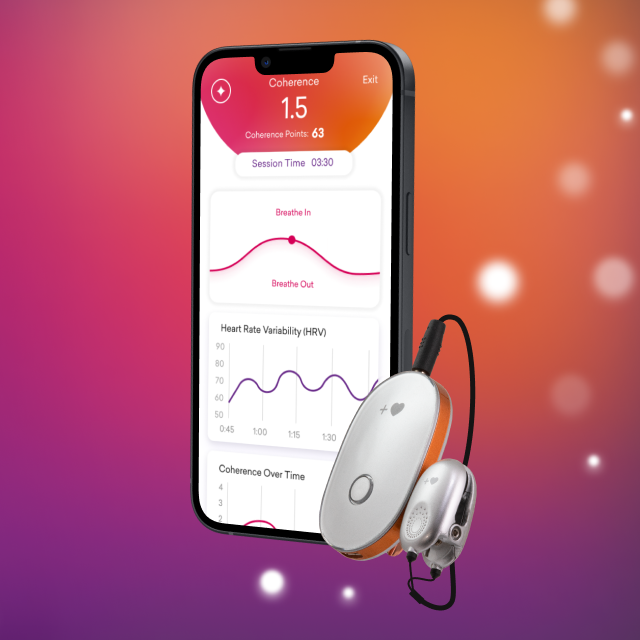
For those who want to dive deeper or need support in their recovery journey, there are certified HeartMath® coaches and health professionals who integrate these techniques into their clinical or coaching practices for self-regulation.
You can receive personalised guidance on HeartMath techniques, and be introduced to the use of HRV biofeedback technology — a small sensor that, in integration with the HeartMath App, gives you a real-time ‘internal look’ at your heart rhythms, to help you see exactly when your body moves into a state of healing coherence.
Unlike wearables that just track your HRV, HeartMath techniques focus on the power of your emotions to shift you into coherence, where your heart rhythm becomes smooth and organized, calming your nervous system in real time.
Would you like to know more?
What I hear from clients who started to use these tools - and what I experience myself - is a sense of empowerment that comes from being able to transition at will into a state that effectively enhances wellbeing and creates better conditions for health and healing.
If you feel drawn to know more about this approach to health, as one of the modalities I utilise in my coaching practice, hit reply to this email with your thoughts or any questions you may have.
References:


Comments